Showing posts with label student stories. Show all posts

Monday, September 1, 2008

Wu Tang bringing the ruckus to 6/7th period

One of the things in the new school year that is really leaving me bemused is the different personalities my 9th grade classes are taking on. I teach four of them, and 1st, 2nd, and 10th periods are all the same so far: quiet, to the point of nearly having to pull teeth to get them to raise their hands. However, period 6/7 is a completely different story: the kids are chatty and the class is loud. I even had to threaten detention on Friday, a day I really didn't want to host detention after school. I haven't treated this class any differently than the others. My standards are strict and consistent. Yet, this class has been pushing my limits all week. Strange.

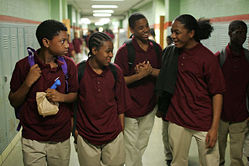
It probably has a lot to do with the young man who said his name was "Wu Tang" during Summer Bridge. He's brimming with personality and humor and he's always talking (often to himself). I like him a lot, and I can tell that he's testing me every moment of every class period. He will do or say something and look to me for approval or disapproval. Unfortunately for me, he makes me laugh sometimes, so occasionally I fail the test. I think he wants to do well, though, and I'll use his earnestness to my advantage throughout the school year. He also wants to play baseball in the spring, so that should help as well.

Wu Tang is not the only reason the class' personality is totally different than the others. There's also the kid up front who alternates between sleeping and chatting incessantly with the girl next to him. And the bouncy little girl who asked to change seats on the first day because she couldn't see the board, but now I think it was so she could sit next to her friends. Lots of personalities. And just at the perfect time for the blood sugar from lunch to start kicking in. I'll either crash and burn with this class or be envigorated by their energy every day. Probably a little of both.

Sunday, August 31, 2008

A problem, and a solution

The tall boy with the easy grin in the back row motioned me over. I walked over to his desk, and his hand continued to beckon. He wanted me to crouch down so he could whisper me something.

"Okay, I've got a problem, and, I have a solution," he whispered, with a sense of urgency.

We were in the middle of our summer reading quiz. He seemed to have his speech memorized.

"I didn't really do my summer reading. See, what had happened was, I got the assignment late, and then I had a real busy summer, and, you see, I, uh, don't read that well, and I just couldn't read the books that fast." (Note: "what had happened was" is perhaps my favorite piece of Baltimore youth dialect.)

His eyes averted my gaze when he gave me that last fact.

I nodded, waiting for his "solution" to the problem. As a rule, I kind of hate the way we do 9th grade summer reading, at leat a bit. Before the 9th grade, I've never met these kids; I don't know what level they're at. I don't even know if they receive or understand the assignment. I definitely want the kids reading in the summer, but hate many aspects of how we bring that goal about where I teach. I wish our 9th grade summer reading assignment were one long book the kids have to read (this year, it was three, two for English and one for Humanities), and wish we had a departmental policy about students who don't receive the assignment. I get resistance with both of these motions.

Ironically, I kind of find myself in charge of summer reading for my department, mostly because no one else seems to want to do it. See, I do like the idea of summer reading, and like what I hear other schools doing. And I love studying the Summer Reading table at Barnes & Noble. With this in mind, I do my best to make the task as palatable as I can for the kids within the system under which I teach. I have integrated choice into the summer reading novels, so now students at least get to choose much of what they read from a list. I have de-emphasized their importance during the school year, so kids don't automatically fail if they haven't read the books. I have, at least in my own classroom, brought some sort of flexibility in terms of late additions or derilect parents who don't go to spring orientation and don't make their kids go to Summer Bridge. Not the kid's fault, so I try not to make it irrevocably hurt them. One they are under my care at the school, I can hold them accountable for things they do not do, regardless of parental involvement (obviously some will have to work much harder because their parents are completely uninvolved, and I tell them that - that they must work harder), but find it very hard, and a bit immoral, to hold them accountable for summer work if they never receive it.

I've never been totally successful with making summer reading a totally educational sound entity at my school, but like a lot of the direction that it's heading. Basically, I want the kids reading and thinking over the summer. This year's participation is much better than last year's, so that's progress.

Anyhow, I looked down at the kid, waiting for his solution.

He had waited for the first part of his memorized speech to sink in.

"So, my solution, is that I'm going to work really hard this year, and make sure this never happens again. I'll make up these points by working ahead and doing any extra credit. And I promise you I'll always have my reading done from here on out."

I've never heard a better solution. He'll be a little behind after failing the little summer reading quizzes, but we start Fences on Wednesday and I'm sure he'll be into that.

Saturday, August 9, 2008

How it feels to be colored me

Today was our 'How It Feels to Be Colored Me' bag day, where we read the Zora Neale Hurston essay the previous day, focusing at her conclusion, in which she writes about seeing herself as a "brown bag of miscellany." The next day - today - we all brought in our own bag of miscellany and presented to the class.

Most kids remembered. Some put some thought into it. Some clearly did it just before class, as the girl with the McDonald's bag, in which she had her I-Pod (to represent her love of music), her pencil (to represent her love of writing), and her lip gloss (to represent her girly-girlishness). But others were very moving and revealing.

The one I remember most didn't bring a bag, though. He forgot. But as we came to this young man, this quiet kid with glasses who has come late every day this week, sitting in the corner, he stomped his feet, saying that it represented him being in school, and that's important, because of the pressure he feels to be the first male in his extended family to graduate high school. And that was cool, and gutsy, and made me pretty glad I'd done this slightly cheesy activity.

Thursday, July 10, 2008

The Taming and Tierra

Today I left the house at 6:40 am and did not return until 12:20am. A long day, and the alarm clock goes off just before 6am tomorrow again. I don't remember getting so little sleep in a long time. Not much time for reflection tonight.

However, I will jot briefly down what I'm thinking about the plays. I actually said something in seminar today, my first comment in two days, and later received one of the more memorable compliments I've ever received in an academic setting. Basically, I'm feeling that in Shrew Kate isn't really "tamed" so much as she just learns duplicity; she gains range, which is a type of strength. She takes on a role, which is something the majority of the characters already can do, most notably the foil character of Bianca, who is able to shift her personality with her intended audience, but more obviously all the characters whose roles transform (Sly, Tranio, Hortensio, etc).

However, this still doesn't change my initial view that the text is pretty sexist and mean, but it does add layers. And, today on the way home, and gazing at the face of Mark Twain sternly staring out from the cover of Time magazine, I'm struck how the text reminds me of Huckleberry Finn. My feelings about that novel vacillate all over the place. I think it's a worthy but risky teach. I don't buy the bullcrap that it's a great anti-Racist novel, nor that it's a racist novel. I find the characterization of Jim to be troubling - yes, racist - at times, and always flinch when I hear, as the Time magazine proclaims, that it's a great rumination on race in this country. I just don't buy it, but I also don't buy the otehr extreme, that it's a flat out racist text that shouldn't be taught, primarily because of the N-word. So I'm somewhere in the middle, ready to argue either side.

It's a text where analysis reveals layers that make the reader think that it might not be the racist text that it appears to be on the outset. Same with Taming of the Shrew, which subsequent reading and analysis reveals can be considered a less troubling and sexist text than it is, and significantly more interesting. The question is, is it possible to get adolescents far enough there for them to get that this further analysis can lead to richer, different meanings? And is it worth it, or can a different text be chosen?

If I were to teach American Literature again this year, I would not have spent any time with Huck. Not because I think it's racist, or because of fear of the N-word in a classroom of nearly 100% African-American students, but because I just don't think it's that good of a book, and certainly not one that will make kids like to read. I wouldn't want to risk a cursory going-over of the text, lest they believe in a knee-jerk fashion that Twain is a racist, and don't particularly think it offers things that other texts don't offer better or richer.

I probably think the same about Shrew. I just don't think I want a piece of literature that is, on its outset, so damn sexist at first. I don't think I do, at least.

*****

I was grabbing some coffee this morning at 7-11 when I felt a hand clasp my shoulder. Last year in the 9th grade, "Tierra" was always like that; one of my most enduring memories of her will be, after a particularly tough period with my horrible 4/5 class, she came over, told me she was sorry the class was so loud, and patted me on the shoulder. The gesture would feel stranger if from a different student, but "Tierra" sort of has this calming aura around her, something that I hope she continues to use, something that, actually, reminds me of myself.

Such a transformation she made this year, from one of my roughest-around-the-edges girls to a grade of an 88 and, often, a complete pleasure to have in the classroom. She lives in my neighborhood and is the most boyish little girl I've ever met, a fact that gets her into trouble sometimes, but the kids are generally very accepting. "Tierra" - who, you should know and get a picture in your head, I used to call "Snoop," as in from The Wire - smiled, told me she was going to work, and groaned when I told her I wasn't teaching English 2. She's a good one.

I actually really miss my students this year this summer more than I have in a long time. I think I liked this last 9th grade class more than any in a while.