Showing posts with label Book recommendations. Show all posts

Sunday, February 1, 2009

Finished Oscar Wao

I just finished The Brief Wondrous Life of Oscar Wao. It was a pretty amazing read, wise and funny. Diaz's writing just leaps off the page.

It's our departmental book club book this month, and I'm sure the question we'll be asking ourselves is whether it's teachable. We have a pretty liberal policy at our school, and I'm sure the kids would love this book. There's plenty to analyze in it, plus a lot that we could learn about world cultures. But it's also raunchy at times. Very questionable.

Probably a no. But on the English Teachers Ning, teachers are talking about success teaching it... hmmm...

Either way, a great read.

Friday, January 2, 2009

Happy 90th Birthday, JD

The list of books that have changed my life is a long one indeed. When I read The Color Purple for the first time, I was wowed by its style and by how it made me, a late-20th century white guy living in the midwest, feel like I was the kindred spirit of Celie, a black lesbian living in the deep south in the early 20th century. It made me realize that literature bridges gaps like this. Hearing Alice Walker speak cemented the feeling; she made me feel empowered in ways that I can't quite explain even now, 12 years later.

With To Kill a Mockingbird, I can track my maturity as a teacher with how well I can teach this book. I have learned this book by teaching it, by noticing new things every time. I'm known as the mockingbird expert at school, and have obsessed over it at great lengths. And I love teaching it, and the kids really end up liking it.

Both Life of Pi and Bee Season were from the same era, about five years ago. Both made me question my existence and my beliefs, and both still resound today.

Other books I associate with places: I cried at A Lesson Before Dying as I was moving to Baltimore, its tapes playing in my parents' van. A Farewell to Arms packed a whallop when I was in Italy. I remember the ending being spoiled for me but not minding because it was that good. The Wind-Up Bird Chronicle is one of the longest, funniest, and oddest books I've ever read, and I associate it with South Carolina, and a tumultuous week on the beach.

Song of Solomon, The Elephant Vanishes, and Fun Home are books that I associate with turning 30. There was a time in my life when I felt exactly like Milkman Dead. I still do, in fact. When will my journey to find my(gold/self) happen? When will I leap?

But it's J.D. Salinger's The Catcher in the Rye that probably most made me realize the ever-changing quality of literature. I first read it in the 12th grade, and didn't like it - Holden was whiny, the book didn't go anywhere. I read it a second time six years later, while student teaching in Lansing. This time, I realized Holden's cynicism was as mask, and that the book was actually hopeful, and very, very sad. I was amazed that the meaning of literature could change for me so much just by what point in my life I was at. For a couple of years after that, I read it every year, charting my own maturity and progress through this life by how I reacted. I found new wrinkles in it - what's up with that teacher? what exactly happens at the end? I named my dog Holden.

J.D. Salinger turned 90 yesterday. Happy Birthday, JD. Here's hoping that when you go, you'll be leaving boxes and boxes of unpublished books for us all.

Tuesday, September 16, 2008

The White Boy Shuffle

This is a call for any ideas, thoughts, or lesson/unit plans about teaching Paul Beatty's The White Boy Shuffle.

I was really excited, but now I'm getting cold feet. It pushes the bounds of high school curriculum more than any book I've ever taught except for perhaps The Adventures of Huckleberry Finn (which of course has the 'classic' label... and no F-bombs). I think the kids deserve to read a literate and raucous modern satire on race, especially after hearing the same thing from the white perspective in the 10th grade with Huck. It's a superb book, highly-praised and poetic. The kids will love it and get a whole lot out of it. But I want to know if anyone else has tried this. Please email or post. I've gotten one google hit already earlier from "teaching The White Boy Shuffle", and this is a blatant attempt at more. And some help.

It's set for March/April, so we've got plenty of time.

Thursday, July 24, 2008

Finishing up summer reading

For the most part, I detest commuting. This is significant, because this was actually part of the appeal of the TSI to me - living another life, an unfamiliar one, and one that a lot of people live in Baltimore every day - the life of a commuter to Washington D.C. I have a lot of respect for those folks, now. Mostly, my hatred for it involves the trains, and the feeling that my life is dictated by them. In my real life, I'm often a couple of minutes late to places. It's not a big deal. The train, though, is unforgiving. Today, the 7:15 train left at 7:14 (the Penn station clock time, within their 5 minute range), and being a couple minutes late here means I'm getting to Washington about 40-45 minutes later than I wanted to. It's just so unforgiving. I still make it to the Shakespeare Folger Library before anything starts, but it's (quite literally) a sprint the almost-mile or so to the institute, and no breakfast, etc. It's happened already about 3 times, and it makes the morning stressful. (And then whenever I want to rush somewhere, the train is 5 minutes late, or the electricity gets cut off and it stalls for 20 minutes, or some other malady occurs.)

However, the actual train ride is pretty good, when I get a seat, because (here's where I return the blog to teaching), in the last two weeks, I've read four of the five 9th grade summer reading books: Marcus Zusak's The Book Thief (absolutely phenomenal, so exciting and moving, and I can't wait to write about it more), Ron Suskin's A Hope in the Unseen (I've written about this one enough already, probably, but, suffice to say, I think everyone should read this book... and it's the Maryland's State Book this year), Daj Sijie's Balzac and the Little Chinese Seamstress (a bit of a snoozer), and, today, Allan Stratton's Chanda's Secrets (pretty decent, perhaps a bit too preachy, but I was still moved).

Kids have to read Hope, and then get their choice of any of the other ones. I have one more left - Edwidge Dandicat's Breath, Eyes, Memory. I'm sometimes bored by Dandicat - Farming of the Bones was a bit of a snoozer, despite the excellent title and some nice passages - so we'll see how I like it.

Monday, July 21, 2008

Next year's IB Curriculum

One of the things that is freaking me out a bit - with now less than a month before teachers report back to school, and with nary a day off until then - is the lack of a curriculum for our IB English III course. The fault is our own; we wanted to change it up a bit, and said we'd read a bunch this summer and email each other, but both of use have been too busy to do it.

Two of us teach the course, and we have to decide the texts together. There are two sections to the Junior year - World Literature and School's Free Choice. For the former section, we have to choose three works from a long (very long) list of books in translation. For the latter section, we pretty much have free reign.

Two years ago, my picks (alone, as I was the only teacher) for the World Literature part were The Sorrow of War by Bao Ninh (translated from Vietnamese), The House of the Spirits by Isabel Allende (translated from Spanish, from Chile), and Death and the Maiden by Ariel Dorfman (translated from Spanish, from Chile). This year, we stuck with Allende's text, and added Haruki Murakami's The Elephant Vanishes (translated from Japanese) and Manuel Puig's Kiss of the Spider Woman (translated from Spanish, from Argentina).

In 2006-2007, I chose Capote's In Cold Blood, Shelley's Frankenstein, Murakami's The Elephant Vanishes, and Morrison's Song of Solomon as my Free-Choice Books. I wanted a non-fiction piece in there (Capote), a 19th century piece (Shelley), a late 20th century great American novel (Morrison), and another translated text (a requirement, actually, and it was Murakami).

In 2007-2008, we chose Shelley's Frankenstein, Morrison's Song of Solomon, Pamuk's The White Castle (the aforementioned translation requirement), and Shakespeare's Othello as our "Free Choice" texts.

So, what do we want to do this year? I'm not sure. We've decided on two texts: The White Boy Shuffle by Paul Beatty, the most daring piece of literature I've ever attempted teaching, and The Wind Up Bird Chronicle by Haruki Murakami, which just extends the highly successful Murakami short stories that we've taught at our school for years.

I think Beatty will replace Morrison (Song of Solomon is one of my all-time favorites, but I don't want to get sick of it by teaching it every single year, and just think the kids will really respond to Beatty) and Murakami's novel will replace his short story collection. Otherwise, I don't know much else.

If it were up to me, I think this is what I would do:

Part I: The Wind Up Bird Chronicle, The House of the Spirits, and then a short work, like The Metamorphosis or Death and the Maiden.

Part IV: The White Boy Shuffle, King Lear, Love in the Time of Cholera or Hundred Years of Solitutde (Marquez), and Frankenstein

I think my cohort prefers Othello to Lear, but the more I think about Othello, the less I'm into it. I just find the title character to be too easily manipulated, and Iago's racist language doesn't ever get rectified at the end. I mean, I think it's a more troubling portrayal of a black character than, perhaps, Jim in Huck Finn. Not that I shy away from negative portrayals of race, they sometimes create interesting discussions, but the person I'm discussing this with is a big anti-Huck Finn kind of person, so I'm especially interested in this issue. My primarily African-American students were definitely uncomfortable with all that animal diction used to describe Othello, in ways that I didn't notice about the use of the N-Word in Huck or other texts we've read; I think it's because the kids are desensitized to that word a bit, and probably weren't expecting similar language from Shakespeare.

Another anti-Othello note is that our curriculum is already pretty male (I wish I could find another really good female World Lit text), and Othello's lack of strong female characters is pretty appalling, especially when compared to Lear.

My cohort loves Marquez, and I'd love to give him a shot. She's kind of over Frankenstein, and I'll let her talk me out of that, as long as we get at least something in there 19th century (though I do love Frankenstein, and the kids like it too).

Oh, and the summer reading was Lahiri's The Namesake and Foster's How to Read Literature Like a Professor.

It will be interesting to see what we come up with. This was her email to me today, from England: "don't worry about the curriculum. it always, always gets done. we should probably just try to start with something familiar to the two of us. i'm giving you creative liberty. run with it!"

I think I'm going to take her up on that.

Our goals for the World Literature section generally are to provide exposure to three different cultures, and/or, provide interesting comparisons and contrasts. Students must write an original Link Paper connecting two of the works as their major assessment for IB, so this is also a factor.

Monday, July 14, 2008

Information about One Maryland, One Book

I've been posting a lot about A Hope in the Unseen lately (so good!), and I realized I should give it some context: It is the state of Maryland's Book of the Year. I've cut and pasted some info below. It's how I was able to secure a few hundred free copies for my students.


Imagine if all five million Marylanders read the same great book at the same time.

The Maryland Center for the Book, a program of the Maryland Humanities Council, is pleased to launch One Maryland, One Book—Maryland’s first-ever statewide, community-centered reading program designed to encourage everyone in the state
to read and discuss one common book.

This year’s selection — A Hope in the Unseen by Ron Suskind — is rich and multilayered. It was selected not only because it offers the opportunity to discuss important and highly relevant topics such as education and socioeconomics, but also because it presents the opportunity to talk about race and race relations
in Maryland and in America—a common theme running through the Maryland Humanities Council’s programming in 2008.

Get the Book.
Pick up a copy of A Hope in the Unseen at your local public library or bookstore and start up a conversation with your family, friends, co-workers or even the person sitting next to you on the bus or train. This is your chance to take a moment to have a great conversation that moves beyond the weather or
what you did today. Join In.

We invite you to join Honorary Chair, Maryland’s First Lady Katie O’Malley, and millions of other Marylanders at one of the many conversations and related programs happening aroun the state in August, September and October.

To find One Maryland One Book programs in your area, go to www.onemarylandonebook.org and click on the Calendar.

Finishing A Hope in the Unseen

I finished the last chapter of Hope in the Unseen on the MARC train, and the last lines of the text made the tears well up in my eyes, to the point where I was glad the car was mostly empty because I might have been embarassed. I was so into the afterward that I couldn't put it down, and literally walked and read all the way to my car, then sat in my car to finish and savor the last few paragraphs. It's now completed.

I'm not sure how I'm going to handle it with my incoming students. I start meeting with them on August 6th, which is the day after the Teacher Shakespeare Institute ends, so it's something I have to think about right now. Students should, theoretically, have the book and their work completed. But these are not-quite 9th grade students, and I am sure that the level of completion will vary. I want them right then, during Summer Bridge, to see what it feels like to not have reading done. I want to give a check quiz, and, while it cannot actually count for a grade (and this is the point - I want not doing the summer reading to become less punitive, and more of a teaching moment), I want students to realize that if they don't do their reading, then doing well in high school will be impossible. Then, I want to do some activity with the book; I haven't figured out what just yet.

The assignment that I came up with earlier - before I had finished the book - is aligned with MYP curriculum standards (that's the language about "Approaches to Learning" and "Health and Social Education"). I know students are working on them, because I'm getting questions in my e-mail box every day.

As you read, keep a reading journal that addresses the following topics. Make sure to address all the questions and proofread. Each journal entry should be 2-3 pages, typed and double-spaced in Times New Roman font.

Topic #1: Approaches to Learning

Throughout their lives, people learn both in school and out of school. As you read, take notes about how Cedric approaches his education, in terms of strategies, attitudes, and motivations. How must he adjust once he goes to college? How do your own strategies, attitudes, and motivations to learn compare to Cedric’s and how do you think they might change (or have to change) once you begin high school?

Topic #2: The Importance of Sacrifice in a Person’s Health and Social Education

Cedric, as well as his mother, make numerous sacrifices throughout the book. Do you think they were worth it? Would you have done the same things? How do Cedric’s sacrifices compare to the sacrifices made in your life? What sacrifices are you willing to make in high school to achieve your goals later in life?


That's what they'll be coming in with. I have to figure out what to make of it all in the sessions that begin on August 6th. Something that will (a) reward reading of the book; (b) encourage reading of the book if they haven't yet; (c) inspire thinking about the book for those who have read; and (d) inspire thinking about the issues in the book for even those who haven't read.

Saturday, July 12, 2008

A Hope in the Unseen

For summer reading, all of our 9th graders will be reading Ron Suskind's A Hope in the Unseen, a non-fiction account of a black kid from a bad city high school in DC makes it to Brown University through hard work and faith. A big part of choosing the book was the fact that it's the State of Maryland's Book of the Year, meaning that I was able to secure some free copies for my students, as well as can expect visits from Cedric Jennings, the book's non-fictional protagonist, as well as his mother (an important figure in the book) as well as the author, Ron Suskind. I believe they will be speaking in the area throughout the year, as the state encourages everyone to read the book.
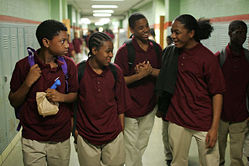
I've been reading the book on the train to DC, and have nearly finished it. I don't want to finish it, because the experience of reading it has been so joyful. It's one of those books that I'll probably remember forever, and I can't believe just how moved I've been by it. It's funny, sad, inspiring, and everything else. I see my students in Cedric Jennings, and see my own experience in college (we're exactly the same age, both graduating high school in 1995) as a strange parallel - albeit totally different, I had similar roommate squabbles with my very-different-background roommate, and similar questions about what path my life should follow - to Cedric's. I've also been strangely moved by the fact that the book takes place in Washington, at least most of it. In one intriguing passage, Suskind begins a passage with the description of a building that sounded vaguely familiar. I continued reading, and it turns out he was describing the Supreme Court, which is now a block away from where I'm working/studying, which I walk by every morning. Cedric visits Justice Thomas as a high school Senior and has an especially strange exchange with him.

I'll finish the book tomorrow, then figure out how I'm going to approach the text when the incoming 9th grade students come on August 6th. They should be finished with the text by then, and I'll have 60 minutes to spend with all of them at that point, in a session devoted just to that text, and I need to figure out exactly what I want to do with it. We'll see.

I'm really glad my librarian passed the book onto me.

The book's description (via Publisher's Weekly): YA-Cedric Jennings is the illegitimate son of an off-and-on drug dealer/ex-con and a hardworking, badly paid mother; it is her single-minded vision to have the boy escape the mean ghetto streets unscathed. Cedric has listened to her and is, as the book opens, an A student at a run-down, dispirited Washington, DC, high school, where he treads a thin line between being tagged a nerd and being beaten by gang leaders. Suskind, a Wall Street Journal reporter, follows the African-American youth through his last two years of high school and freshman year at Brown University. Inspirational sermons at a Pentecostal church, guidance from his mother, a love of black music and singing, and a refuge in the logic of math combine with the young man's determination and faith in the future to keep him focused on his goal of a topflight college education. Despite many low moments and setbacks, Jennings's story is one of triumph within both cultures, black and white, which together and separately put tremendous obstacles in his path out of the inner city. It is a privilege and an inspiration for readers to accompany Cedric on part of his long, difficult journey to maturity. His journey continues at this moment, since he is now a senior at Brown this fall. YAs of any background will be introduced to new worlds here.