Wednesday, August 6, 2008

Shorts

I taught in shorts today. Yes, that's how hot it was in the school. I'd never wear shorts during the regular school year, but, damn, was I ever glad I did today.

The air temperature hit at least 91 today, with humidity, but I'm pretty sure it was at least 10 degrees hotter in my classroom.

*****

Today I taught that same lesson I started on Monday times #5, #6, and #7. Tomorrow, it's #8 and #9. That should be about the time it gets really good.

*****

It's funny, but my timing gets way off sometimes, probably because I'm finding the need to do things in radically different orders nearly every class period, just to make things fresh. I've also become notorious as the teacher who keeps the kids after the top of the hour, leaving a crowd of kids outside my room waiting for me to stop talking. You do it once, and it happens nearly every class period because it's a cycle that repeats itself.

*****

I met the most interesting kid so far in Summer Bridge today. I wish I could tell you all his first name, because that was pretty interesting in and of itself. But, otherwise, he walked into my room, late, wearing sunglasses. As I am prone to do, I went over and whispered for him to take off his sunglasses and walked away without looking at him, so he didn't feel the need to challenge me on it and could take them off without saving face. Which he did, but he also apologized, rather profusely, and ended up jabbering through much of the first ten minutes of my class. At first, with the profuse apology and constant jabbering, I got the feeling he was some sort of insincere kid, but, after a few minutes, it all clicked, that he was really genuine, that he really wanted to do well. He couldn't shut up at all, but somehow ingratiated himself into my good liking by the time 10:11 rolled around. Seemed a good reader, had some really interesting things to say about the Edwidge Dandicat novel he read over the summer, told me he has to get up at 5:30am to catch the 6:15am bus to get to school every day on time. He's a bundle of energy and will probably take up half my energy every day in his class periods, but I think I'd still be happy to have him on my class list when I get them in a couple of weeks.

One of my favorite parts of that group was this young man playing off a white girl who also read the Dandicat novel. They don't know it yet, but they're both bright active readers who are my favorite kinds of kids. Both wanted to be heard a lot today, both raised their hands for every question, yet their other responses couldn't be more different. I love that sort of variety. Sign them both up for my class in the fall.

Also loved to see the little brothers of several kids I've taught before. Made me feel both old and good at the same time, emotions which, when combined together, make me feel ready for my 31st birthday, which is approaching in one week.

Tuesday, August 5, 2008

Certification and Aspiring Leaders

My Standard Professional Certificate I expires in June of 2009.

According to all the confusing websites I've been reading, and according to what I understand of it all, I have to take a Reading course sometime before 90 days past that date to get a new certificate.

However, a letter sent from the certification office to a colleague has gotten my hopes up. See, while I haven't taken any Reading classes in the last five years, I've taken lots of classes - including getting my MAT in Secondary Education at Towson University this past May. According to my colleague's letter, she needs four things to get her Advanced Professional Certificate - a conferred Master's Degree (check), a Professional Development Plan (a rubber stamp check), Verification of 3 years of satisfactory school related experience (check), and a letter requesting advancement to the next certificate (check). No mention of a reading course.

I'm really hopeful that I won't have to spend time this fall taking a silly Reading class, which, by all accounts, are kind of jokes. I've had several colleagues take them, and everyone's attitude is that they're jokes, including the professors. I'm sure I gained more about teaching reading in just a week of the Teaching Shakespeare Institute as I will from these reading classes.

My other current dilemma is whether to get involved in the Aspiring Leaders Program through Hopkins. In this program, BCPSS will pay half of your tuition to JHU to get an administration certificate. I have no interest in being a principal or assistant principal, but perhaps would like the chance to be a department head or curriculum leader of some sort sometime. It's a three-semester program of 18 credits. Would probably be tough and I probably deserve a year just to work on my teaching after five years with a second job and three years working on an MAT, but I'm still tempted...

Anyhow, some of the decision hinges on whether I have to take this Reading class this year, and hopefully that question will be answered in the email to the Certification office I sent this evening. I wonder what the chances are that the email will be answered? I'll keep you updated. The folks at North Avenue are not known for replying to requests for help. I've had horrible experiences with the Certification folks at North Avenue, and was pleasantly surprised to be emailing a different name this time - the other lady must have left.

Spiels and Hope

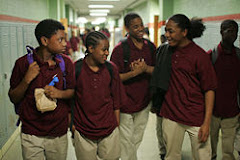
During Summer Bridge, I am teaching the same lesson nine times over the course of the week. In past years, I've been terribly bored with this schedule; it just gets pretty tedious to say the same things over and over and over again to different groups of incoming 9th graders.

While I still might get bored this year, I find myself a little more accepting of the schedule so far. First of all, I'm really in need of a vacation and some down time after the month of intense Shakespeare study, so not having to plan a new lesson every night gives me some time for myself and my own endeavors (including cleaning my office, which is stacks and stacks of junk after the month of being too busy to do anything about it, plus finishing up syllabi and course maps). Secondly, at least for the first few times through the lesson, I'm intrigued by how it takes shape.

See, I'm basically giving a lesson on A Hope in the Unseen. But I start out with a round around the room, where I hear from the students their name, their middles school, and their favorite book they read in middle school. Sometimes I'll ask them other things, like if they've had relatives who went to the schoool or whether they've done their summer reading. Then, we take a "practice quiz" ovfer the book, something I tell them is a way to figure out if they're ready for August 25 (the first day of schol). It's 15 questions, multiple choice, and we score it together; I never see their scores and tell them to take it for what it's worth.

Then, invariably, I go on little spiels about certain topics:
Spiel #1: "Dreambusters" - in A Hope in the Unseen, Cedric talks about dreambusters, the people who say "You can't" or "You won't," and how he has to ignore them and do his own thing. I tell the students that everyone has their own version fo this, and it's important that we all find the strategies to resist, whether those "dreambuster" come in the form of hallway hangers or forces in our neighborhoods.

Spiel #2: Not taking the easy route - I tell the sutdents that it's easy to float by through high school, to get a grade of a 68 or a 71 average, and do fine by those standards, to "pass" and that's it. You'll get yoru diploma, I say, but not much else. I tell them to work hard, to accept nothing less than an 80 in any class, and take control of their education by ensuring this.

It seems like in every section, I come to these spiels in different ways - they'll be a response to a student's answer to a question, or in my closing remarks - and I'll vary the examples and the way I tell the stories. But, otherwise, they'll be pretty similar. And, even though they weren't part of my rudimentary plan for the lesson, they seem to be doing well with it. Most of them come up with the question, "Why would we have chosen this book for you as summer reading?". What I don't want to hear is that "Oh, we're poor, and we're black, and you all want us to be like Cedric." No. Not true. Cedric was by no means a perfect student; he had no balance in his life, could not adjust well socially, and often was haughty and unaccepting of others. But, we all can take things from Cedric's story and apply them to our own lives, whether it's the refusal to give up, the hard work, the faith, the goal-setting. And, for our students, I hope they see the transition from middle school to high school could have some similarities to Cedric's transition from high school to college.

All in all, a good day, with some great (and still quiet) new kids.

Monday, August 4, 2008

The first reactions to summer bridge

1. They're so little!

2. If only they stayed this quiet all year...

3. Most did their summer reading! And they liked A Hope in the Unseen!

Sunday, August 3, 2008

First draft of Junior IB curriculum...

World Literature / Works in Translation:

Theme: Something about the aftermath of war

1. The House of the Spirits by Isabell Allende
(Aug/Sept)
2. The Unbearable Lightness of Being by Milan Kundera
(Oct)
3. No Exit by Sartre (Nov)

School's Free Choice

Theme: Male Angst and its Consequences

4. The Wind-Up Bird Chronicle by Haruki Murakami (Dec-Jan)
5. The White Boy Shuffle by Paul Beatty
(Jan-Feb)
6. Frankenstein by Mary Shelley (Feb-March)
7. King Lear by Shakespeare (March-April)

Brief explanations:

#1: Funny, lively, epic novel. Introduces magical realism. Female author, lots of strong female characters. Students generally like it.

#2: None yet, except that it's a well-renowned novel and is on the World Lit list.

#3: Haven't read it, but have heard it's a good introduction to existentialism. Plus, it's nice to do a short, modern drama.

#4: Students generally love Murakami, and I think they'd really latch onto his novel. Now, it's 600 pages or so, but hopefully the students will enjoy it as much as they did his short stories (we've taught The Elephant Vanishes for years).

#5: Funny and smart satire about race with which a lot of our students will connect. The troubling Huck Finn shouldn't be the only satirical novel about race that they read. Paul Beatty could be the next great novelist; he's a superb poet. Though this is a risky teach, students will find it fresh and very funny.

#6: 19th century, female. I've never taught another 19th century novel that the kids were so into. Page-turner. Good introduction to Romanticism. Very accessible and not overwhelming in terms of structure. Plus, one of the signs of an educated person is knowing that Frankenstein was the doctor, not the creature. (Note: I usually am not in favor of the "English teacher as gatekeeper" argument, and have never been one to say that "all high school students must read __________", but, geez, this little fact is one that I think everyone should know. Plus, that "Wherefore art thou, Romeo?" does not mean "Where are you, Romeo?")

#7: I think the family drama, the question of fairness, and the themes of remaining true to yourself and to others will resonate with students. Honestly, I've never experienced such a page-turner as this one when reading Shakespeare. Kids at our school read Romeo and Juliet their 9th grade year and some combination of Hamlet, Macbeth, and The Tempest their 12th grade year. Still light on comedies, but I've yet to find a Shakespeare comedy that I much liked (the first two acts of Romeo and Juliet are a comedy, anyway). The last reason I wanted it on the curriculum is that I think I can teach the hell out of it, as a result of the Teaching Shakespeare Institute.

#2 and #3 are my colleague's choices - I haven't read them yet and could nix them.

#5 was my idea but she's all about it.

#1, #4, and #6 are longtime favorites from the curriculum. I'm more into #1 and #6 then she is, but she's realizing how hard it is to find female authors for what our curriculum is, so we need them.

#7 I had to twist her arm to do. Seh prefers Othello. I don't. (I have some huge issues with Othello and did not enjoy teaching it at all.)

We still have a couple of weeks to sure things up. I need to get to reading the Kundera and Sartre books in the next couple of days.

Another education blog in Baltimore

Just caught this one: The Smallest Twine, a funny little blog of an (almost) 2nd-year Math teacher in Baltimore City.

There are only five or six entries so far, but I'm already into the whimsical tone of it all:

After a year of teaching, I've matured a lot and realize that it's not really about me and if the students like me and think I'm cool (because let's face it, I'm not -- although I do have a song about myself to the tune of Fergilicious).

Highly recommended.

Saturday, August 2, 2008

Summer Bridge

On Monday, Summer Bridge begins. I have taught in this program, which gets rising 9th graders ready for their freshmen year of high school, just about every year I've taught, and generally have enjoyed it. This year will be rougher than most, probably, because (a) I get no break between the Teaching Shakespeare Institute and the start of Summer Bridge; and (b) North Avenue has been their worst ever in terms of organization of staff for the program.

For the latter point, allow me this: our 9th grade classes are generally around 330-350 students. Yet, our allowance from North Avenue for Summer Bridge was 9 teachers. The reasons for this appear to be mostly about red tape - some students weren't issued student ID numbers by North Avenue, which puts their numbers off for staffing; others were apparently not counted for other reasons. Regardless, we're going to have that many show up, putting our class sizes for Bridge in the 40 range. From what I have heard, this is the result of a new staffing model from North Avenue, and it's kind of a bummer.

This is one of those things that you'd think would be greatly improved with schools having more independence in terms of funding. And, at first, North Avenue was going to let schools fund this summer program independently. But, somewhere along the lines, they changed their minds. And we're mired in some red tape or something else that is causing us to have some huge class sizes for this preparing-for-high-school couple of weeks.

Classes of 20 or 40, though, you still need bang-up lessons, which is what I've been trying to do all weekend while I fend off the cold from the end of the Teaching Shakespeare Institute. Back to it.